
POSH training in India is structured workplace education that helps employees, managers, and Internal Committee (IC) members understand workplace sexual harassment, their rights and responsibilities, reporting mechanisms, and prevention measures under India’s POSH framework. Beyond the basic POSH training meaning, HR and L&D leaders also need clarity on POSH training certification, delivery formats such as online POSH training, and how sessions should be tailored for different audiences. For HR and L&D leaders, effective POSH training is not simply a compliance exercise — it is part of building awareness and a respectful workplace culture.
This guide answers what is POSH training, its full form, who needs it, what it should cover, and how HR and L&D leaders in India can implement it effectively — including POSH awareness training for the wider workforce and POSH training for employees at every level. It is written for HR leaders, L&D leaders, business owners, managers, Internal Committee members, and employees who want a clear, practical understanding rather than a generic overview.
With years of experience serving as an Internal Committee member and conducting POSH training in India for government bodies, private organizations, and institutions across the country, Dileep Yashvardhan shares practical guidance in this piece to help organizations build safe, respectful, and legally compliant workplaces.
POSH Training Meaning: What Does POSH Stand For?
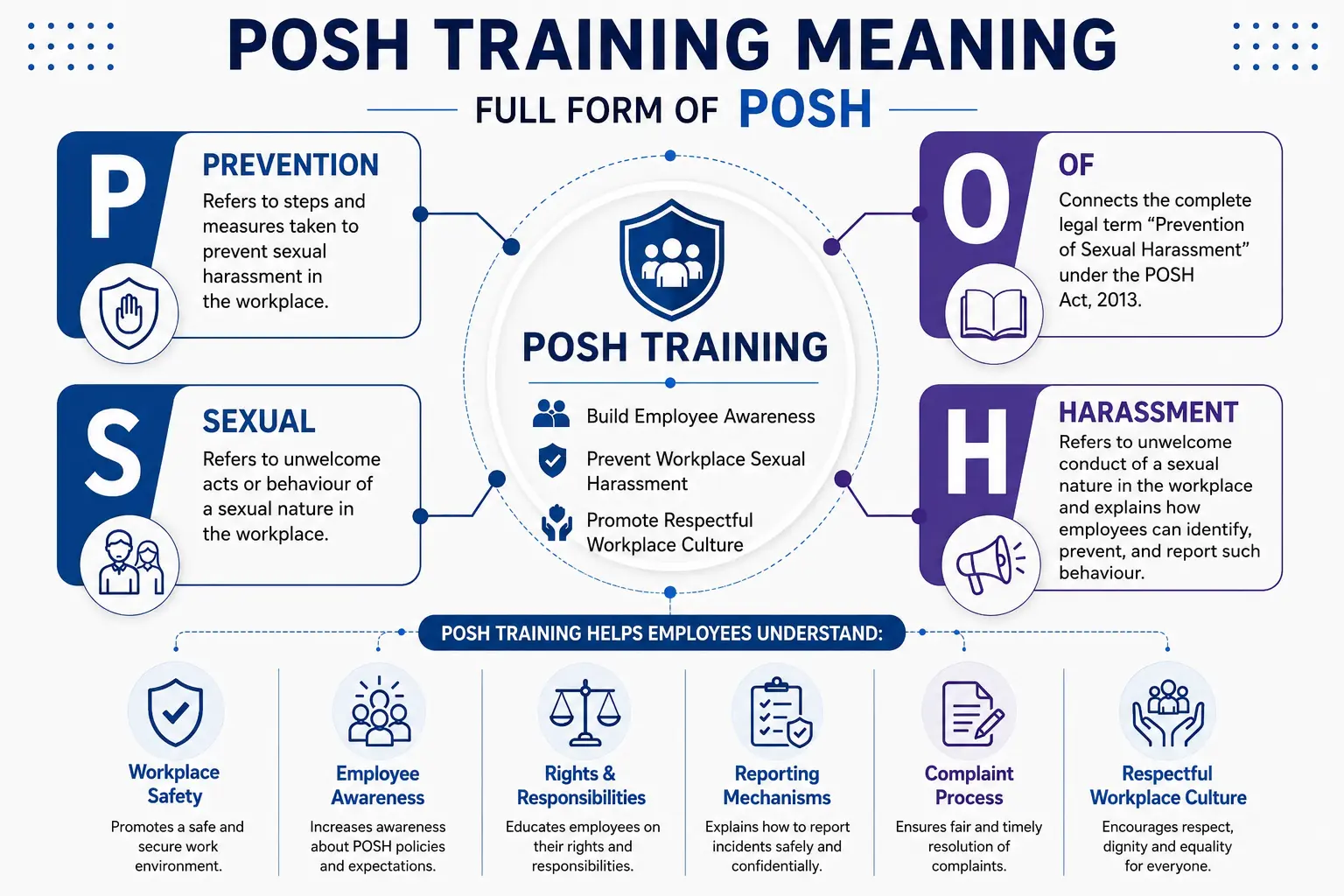
POSH stands for “Prevention of Sexual Harassment.” The training built around this framework helps employees and organizations understand, prevent, and respond to sexual harassment at work, in line with Indian law.
What Is the Full Form of POSH?
The full form of POSH is Prevention of Sexual Harassment. It refers to the framework created under the Sexual Harassment of Women at Workplace (Prevention, Prohibition and Redressal) Act, 2013 — commonly referred to as the POSH Act, 2013. The Act requires most employers in India to take specific steps to prevent harassment and address complaints fairly.
What Does This Training Actually Mean?
In practice, it means teaching employees, managers, and committee members about their rights, responsibilities, and the reporting process related to sexual harassment at work. It typically covers definitions of harassment, examples of prohibited behaviour, complaint procedures, and the role of the organization’s Internal Committee (IC), previously known as the Internal Complaints Committee (ICC).
What Is POSH Training and Why Is It Important?
Its purpose is to build genuine understanding, not just tick a compliance box. Organizations use it to reduce the risk of harassment, help employees recognize and report inappropriate behaviour, and equip Internal Committee members to handle complaints professionally and fairly.
POSH training is a structured awareness program that teaches employees how to identify, prevent, and report sexual harassment at work, while also explaining the organization’s legal and procedural responsibilities under the POSH Act, 2013.
Its importance goes beyond legal compliance. Many organizations in India now see it as part of building a genuinely respectful workplace culture. As part of broader corporate training programmes, POSH training complements initiatives such as leadership development, communication skills, and employee well-being to create safer and more inclusive workplaces. Well-designed sessions help in several ways:
- Employee awareness: Employees understand what counts as harassment, including subtle or non-physical forms that are often missed.
- Prevention: Awareness reduces incidents by helping employees recognize inappropriate behaviour early.
- Rights and responsibilities: Employees learn what protections they have and what conduct is expected of them.
- Reporting mechanisms: Training explains how and where to report concerns, which reduces hesitation caused by confusion or fear.
- Workplace culture: Regular training signals that the organization takes safety and dignity seriously.
- Organizational responsibility: HR and leadership demonstrate that policies exist and are actively communicated, not just documented.
Treating POSH training as an ongoing awareness practice helps organizations reinforce understanding, keep reporting mechanisms visible, and ensure employees remain familiar with their rights and responsibilities.
As workplace expectations continue to evolve, POSH training in India has become an essential part of organizational compliance, employee awareness, and building a respectful workplace culture.
POSH Training in India: Legal Requirements HR & L&D Leaders Should Know
Under the POSH Act, employers are required to implement POSH training in India as part of their broader workplace awareness and compliance responsibilities. This includes constituting an Internal Committee (IC) in workplaces covered by the Act that meet the applicable statutory threshold of 10 or more employees. Where a workplace has fewer than 10 workers, or where a complaint is against the employer, the Act instead provides for a Local Committee at the district level to receive and address complaints.
Key responsibilities under the framework include:
- Constituting an Internal Committee (IC) at each office or branch location, as required under the Act
- Displaying the POSH policy and complaint procedure prominently at the workplace
- Organizing workshops and awareness programmes for employees, as required under Section 19 of the Act (see Sources below)
- Maintaining records of complaints received and their resolution, for annual reporting purposes
- Training Internal Committee (IC) members so they can handle complaints professionally and confidentially
Legal Requirement vs. Best Practice
It helps to separate what the law explicitly requires from what is simply good practice:
| Legal Requirement (POSH Act, 2013) | Recommended Best Practice |
| Constitute an Internal Committee (IC) (where applicable), or refer complaints to the Local Committee where one hasn’t been constituted | Train the Internal Committee (IC) beyond the basics, with case-based learning |
| Organize workshops/awareness programmes at regular intervals (Section 19) | Run structured onboarding and periodic refresher sessions |
| Display the POSH policy at the workplace | Reinforce the policy through internal communication, not just a poster |
| Submit an annual report on complaints | Track training completion rates for internal accountability |
This guide consistently flags which practices are statutory and which are recommended, because presenting a best practice as a legal requirement can create confusion for HR teams.
Is POSH Training Mandatory in India?
Organizing awareness and training programmes is a legal requirement under Section 19 of the POSH Act, 2013 — but the Act does not specify an exact frequency, format, or duration for this training.
This means employers must conduct awareness activities as part of their statutory duties, but the specifics — how often, in what format, and how detailed — are largely left to the organization to decide sensibly, based on its size, workforce, and risk profile. Organizations should not assume that a single onboarding session satisfies the intent of the law; the Act’s language points toward an ongoing responsibility, not a one-time event.
Who Needs POSH Training in an Organization?
Every organization covered under the POSH Act needs to train its workforce, but different groups need different depth and focus. Every organization implementing POSH training in India should ensure that different employee groups receive training appropriate to their roles and responsibilities.
| Audience | Training Type | Key Topics | Recommended Depth |
| Employees | Awareness | Rights, responsibilities, reporting | Foundational |
| Managers | Sensitization | Recognizing behaviour, supporting reports, escalation | Intermediate |
| HR & L&D | Compliance/Administration | Policy, records, coordination with the Internal Committee (IC) | Advanced |
| Leadership | Leadership awareness | Accountability, tone-setting, culture | Intermediate |
| Internal Committee (IC) members | IC training | Inquiry procedure, confidentiality, natural justice | Advanced/Specialized |
| New joiners | Onboarding awareness | Foundational awareness before starting work | Foundational |
| Remote/hybrid employees | Awareness | Same core awareness, adapted for virtual reporting channels | Foundational |
POSH Training for Employees: What Should Employees Learn?
Employee-level sessions should build practical understanding, not just legal terminology. They typically cover the following areas.
Understanding Sexual Harassment. Employees should learn the legal definition of sexual harassment under the POSH Act, along with real examples covering verbal, non-verbal, and physical conduct. Training should also clarify that harassment can occur between colleagues at any level, not only from a senior to a junior employee.
Rights and Responsibilities. Every employee has the right to a safe workplace and the responsibility to behave respectfully toward colleagues. Training should explain both sides clearly, so employees understand protection and accountability together.
Reporting and Complaint Mechanisms. Employees should know where and how to report concerns, who the designated contact or committee is, and what the organization’s complaint process involves.
Role of the Internal Committee (IC). The Internal Committee (IC) is responsible for receiving, inquiring into, and resolving complaints of workplace sexual harassment. Employees should understand its role and composition without needing to know every procedural detail.
Confidentiality and Non-Retaliation. Training should reassure employees that complaints are handled confidentially and that retaliation against a complainant is prohibited. This is often the biggest factor in whether employees feel safe reporting at all.
Real-Life Scenarios and Case Studies. Practical, workplace-appropriate scenarios help employees apply the concepts rather than memorize definitions. For example, a scenario might describe a colleague repeatedly making unwelcome comments about someone’s appearance despite being asked to stop — helping employees recognize how harassment often looks different from dramatic assumptions.
What Is the Difference Between POSH Awareness Training and Internal Committee (IC) Training?
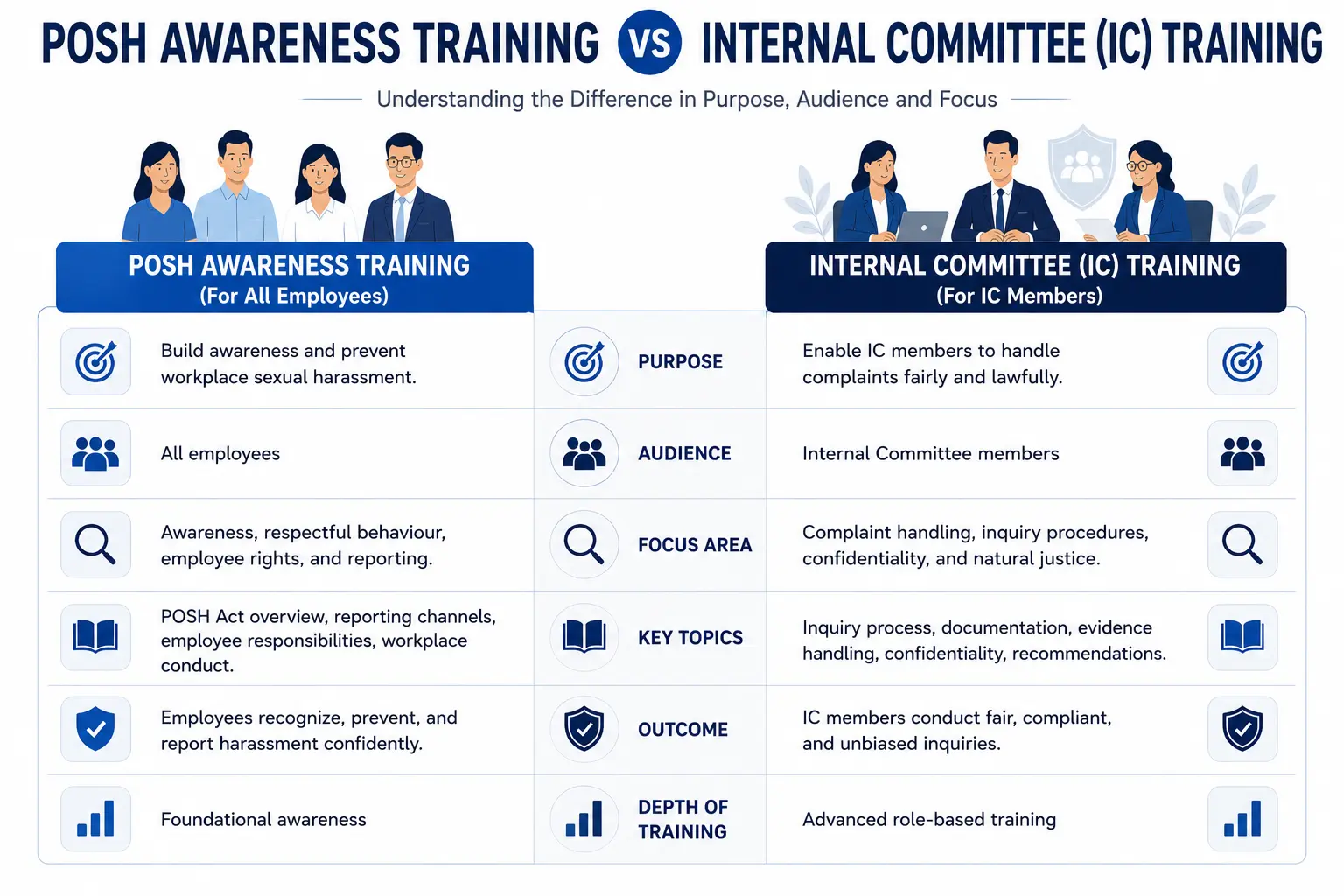
POSH awareness training is designed for all employees and covers general awareness of workplace rights, responsibilities, and reporting mechanisms. Internal Committee (IC) training is a specialized program for IC members focused on complaint handling, inquiry procedures, confidentiality, and legal compliance.
| Aspect | POSH Awareness Training | Internal Committee (IC) Training |
| Purpose | Build awareness and prevent workplace sexual harassment | Enable IC members to handle complaints fairly and lawfully |
| Audience | All employees | Internal Committee (IC) members |
| Focus Area | Awareness, respectful behaviour, employee rights and reporting | Complaint handling, inquiry procedures, confidentiality and natural justice |
| Key Topics | POSH Act overview, reporting channels, employee responsibilities, workplace conduct | Inquiry process, documentation, evidence handling, confidentiality, recommendations |
| Outcome | Employees recognize, prevent, and report harassment confidently | IC members conduct fair, compliant, and unbiased inquiries |
POSH Complaint Process: What Employees Should Know
Understanding the complaint process helps employees feel confident using it, and helps organizations demonstrate a genuinely functioning framework rather than a policy that exists only on paper. At a broad level, employees should understand:
- Who can receive a complaint: typically the Internal Committee (IC), or the Local Committee where an IC hasn’t been constituted or where the complaint involves the employer
- How a complaint can be raised: in writing, through the channel specified in the organization’s policy
- Role of the IC: receiving the complaint, conducting an inquiry, and recommending action
- Confidentiality: details of the complaint, respondent, and proceedings are meant to be kept confidential throughout the process
- Protection during proceedings: the law prohibits retaliation against a complainant or witness during and after the inquiry
- Outcome and next steps: the IC submits its findings and recommendations, which the employer is expected to act on
The POSH Act and its Rules also set out specific procedural timelines for filing and resolving complaints. Because these timelines carry legal weight, organizations should confirm the exact figures against the current Act and Rules (or with a labour law professional) before publishing them as guidance, rather than relying on a general summary.
What Should POSH Training Cover?
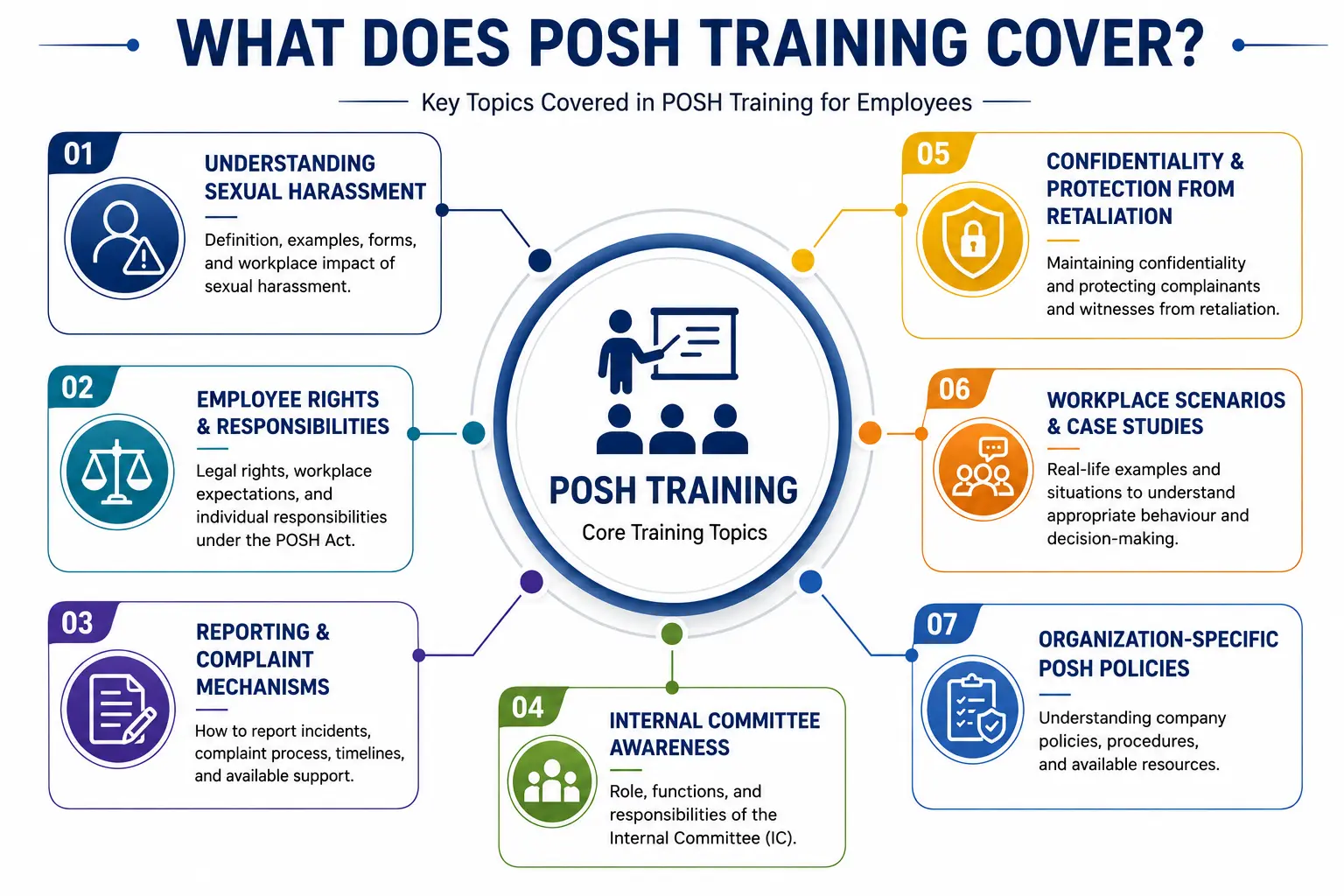
A well-rounded session should address:
- What constitutes sexual harassment
- Examples of inappropriate conduct
- Applicable law: the POSH Act, 2013
- Employee rights and organizational responsibilities
- Reporting process and available channels
- Role and composition of the Internal Committee (IC)
- Confidentiality and protection against retaliation
- Consequences of false or malicious complaints
- Real-life, workplace-relevant scenarios
- Organization-specific policy details and contact points
Types of POSH Training Organizations Should Consider
Different training types serve different organizational needs:
- Employee awareness training — foundational understanding for the entire workforce
- Manager sensitization training — helps managers recognize behaviour and respond appropriately
- Leadership training — Leadership development initiatives often include motivational speaker sessions alongside POSH awareness to reinforce accountability, ethics, and respectful workplace behaviour.
- Internal Committee (IC) training — specialized, procedure-focused training for committee members
- New-joiner awareness — introduced during onboarding, before an employee begins regular work
- Refresher training — periodic sessions to reinforce awareness over time
- Remote/hybrid workplace training — adapted content addressing virtual reporting channels and remote work dynamics
How Often Should POSH Training Be Conducted in India?
Section 19 of the POSH Act, 2013 requires organizations to conduct awareness and training activities at regular intervals, but it does not prescribe an exact number of sessions per year.
As a practical organizational approach, companies may consider:
- New-joiner awareness sessions during onboarding
- Annual or biannual refresher sessions for the existing workforce
- Separate, more detailed training for Internal Committee (IC) members, often when the committee is newly constituted or when members change
These frequencies are common organizational practice, not statutory minimums, and HR teams should treat them as a starting point to adapt based on workforce size and risk assessment rather than a fixed legal rule.
Online POSH Training vs Offline vs Hybrid: Which Is Better for Your Company?
The right training format depends on team size, location spread, and how much interaction the organization wants during sessions. Organizations delivering POSH training in India can choose between online, offline, or hybrid formats depending on workforce size, office locations, and engagement needs. Online POSH training works well for large or spread-out teams, while offline and hybrid POSH training formats often work better for smaller groups or Internal Committee (IC)-specific sessions that benefit from discussion.
| Factor | Online Training | Offline (Classroom) Training | Hybrid Training |
| Cost | Generally lower per employee | Higher due to venue, travel | Moderate |
| Scalability | Easy to scale across locations | Harder for multi-location teams | Good balance |
| Engagement | Depends on format; can be passive | Higher interaction and discussion | Combines both strengths |
| Documentation | Easy to track completion digitally | Requires manual attendance records | Both digital and manual tracking |
| Best suited for | Large or distributed workforces | Smaller teams, Internal Committee (IC)-specific sessions | Growing companies with mixed teams |
Many organizations use online training for broad employee awareness and reserve offline or hybrid sessions for Internal Committee (IC) members and leadership, where discussion-based learning adds more value.
How to Implement POSH Training Across Multi-Location and Remote Teams
Successfully implementing POSH training in India across multi-location, remote, and hybrid teams requires a structured and repeatable process:
- Identify employee groups across locations, including remote and hybrid staff
- Review the existing POSH policy to confirm it reflects current locations and reporting channels
- Map training needs for each group — employees, managers, leadership, and Internal Committee (IC) members
- Choose the delivery format best suited to each group, based on the comparison above
- Conduct the training, ensuring consistent core content across all locations
- Train managers and Internal Committee (IC) members separately, with deeper, procedure-focused content
- Record completion for every employee, to maintain accurate documentation
- Conduct refresher sessions at planned intervals
- Review effectiveness periodically, using completion data and, where appropriate, anonymous feedback
Expert Insight from Dileep Yashvardhan
Drawing on years of experience conducting POSH awareness programmes, Internal Committee (IC) training, and workplace compliance workshops for government departments, educational institutions, and private organizations across India, Dileep Yashvardhan believes that effective POSH training goes beyond legal compliance.
Organizations achieve better outcomes when training is practical, interactive, and tailored to the responsibilities of different employee groups instead of being delivered as a one-size-fits-all session.
“The most effective POSH training is not the one employees attend because they have to — it is the one that changes how they think, communicate, and respond in the workplace. Real awareness creates safer workplaces, stronger trust, and a culture of respect.” — Dileep Yashvardhan
POSH Training Certification: Do Employees Need a Certificate?
Employees typically receive a training completion certificate after attending a POSH awareness session, but this certificate reflects participation, not legal compliance on its own.
It helps to understand the different types of certification involved:
- Training completion certificate: Confirms an employee attended and completed the session
- Participation certificate: Similar in purpose, often used for shorter awareness sessions
- Professional certification: Some trainers or institutions offer certification for individuals who complete more detailed POSH facilitator or trainer programs
- Internal Committee (IC) training or capacity-building certificate: Recognition for IC members who complete inquiry-focused training (this is a training credential, not a statutory certification recognized under the Act)
A completion certificate is useful documentation, but it does not, by itself, prove that an organization has fully met its obligations under the POSH Act. Compliance depends on the overall framework — policy, Internal Committee (IC), reporting mechanism, and genuine awareness efforts — not a single document.
How to Choose the Right POSH Trainer in India
Choosing the right provider for POSH training in India is just as important as deciding to conduct the training itself. Selecting a trainer is easier with a clear checklist:
- Legal grounding: Confirm the trainer has a solid, accurate understanding of the POSH Act, 2013 and related procedures
- Practical experience: Look for trainers who have handled real organizational training, not only theoretical material
- Customization ability: A good trainer adapts content to the organization’s industry, workforce size, and culture
- Communication style: Sessions should be clear, respectful, and engaging rather than purely lecture-based
- Internal Committee (IC)-specific expertise: For committee training, confirm the trainer can cover inquiry procedures and case handling in depth
- Documentation support: Reliable trainers help organizations maintain records of sessions and completion
Dileep Yashvardhan has conducted POSH awareness programmes, Internal Committee (IC) training, and compliance workshops for government departments, educational institutions, and private organizations, helping create safer and more respectful workplaces.
Common POSH Training Mistakes Organizations Should Avoid
- Treating it as a one-time checkbox instead of an ongoing awareness effort
- Using the same training for everyone, regardless of role or responsibility
- Ignoring managers in the training plan, even though they often receive informal complaints first
- Neglecting leadership training, which weakens the tone set from the top
- Skipping dedicated Internal Committee (IC) training, leaving committee members underprepared for real inquiries
- Relying on overly theoretical content with no practical scenarios
- Keeping poor documentation of who attended and when
- Never running refresher sessions, so awareness fades over time
- Leaving reporting channels unclear, especially across multiple locations
- Failing to adapt training for remote teams, who may not know how to report issues virtually
POSH Training Implementation Checklist for HR & L&D Teams
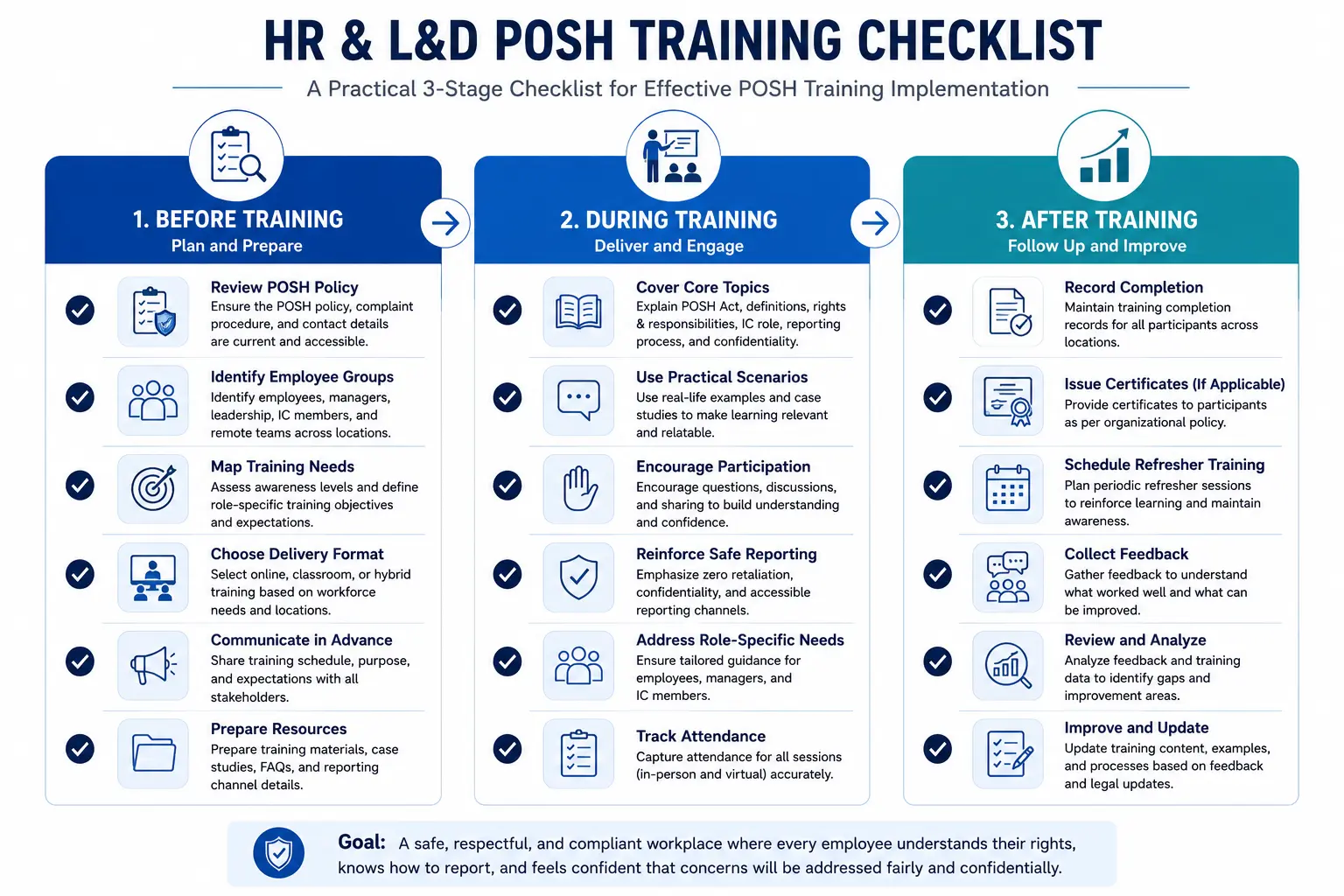
Before Training
- Confirm the current POSH policy is accurate and up to date.
- Identify all employee groups, including remote and multi-location staff.
- Choose the appropriate format for each group.
- Prepare organization-specific reporting details, training materials, case studies, FAQs, and other resources for use during the training session.
During Training
- Cover all core topics, from definitions to reporting mechanisms.
- Include real-life, workplace-relevant scenarios.
- Allow time for questions and discussion, particularly during offline or hybrid sessions.
- Reinforce confidentiality, non-retaliation, and the organization’s reporting channels throughout the session.
- Record attendance accurately.
After Training
- Issue completion certificates or participation records, where applicable.
- Store attendance and completion data for annual reporting.
- Schedule the next refresher session.
- Review participant feedback and use it to assess the effectiveness of the training and improve future sessions.
Frequently Asked Questions About POSH Training
What is the full form of POSH training?
POSH stands for Prevention of Sexual Harassment. POSH training refers to awareness and education programs built around the POSH Act, 2013.
What is POSH training?
POSH training is workplace education that helps employees, managers, and Internal Committee (IC) members understand, prevent, and respond to sexual harassment at work, as required under Indian law.
Is POSH training mandatory in India?
Organizing awareness and training activities is a legal requirement under Section 19 of the POSH Act, 2013, though the Act does not specify an exact frequency or format for these sessions.
Who needs POSH training in an organization?
All employees need foundational awareness training, while managers, leadership, HR, and Internal Committee (IC) members typically need deeper, role-specific training.
What is covered in POSH training for employees?
Employee training typically covers the definition of sexual harassment, rights and responsibilities, reporting mechanisms, the role of the Internal Committee (IC), and confidentiality protections.
How often should POSH training be conducted?
The law requires regular awareness activities without fixing an exact number, so many organizations choose annual or biannual refreshers alongside onboarding-level training for new joiners.
Do employees need a POSH training certificate?
Employees usually receive a completion certificate after training, but this certificate reflects participation and does not, by itself, prove full legal compliance.
What is the difference between POSH awareness training and Internal Committee (IC) training?
POSH awareness training is for all employees and covers general understanding, while Internal Committee (IC) training is specialized education for IC members focused on complaint handling and inquiry procedures.
Why choose Dileep Yashvardhan for POSH training in India?
Dileep Yashvardhan brings hands-on experience as an Internal Committee (IC) member and trainer for government bodies, educational institutions, and private organizations. His sessions are practical and scenario-based rather than purely theoretical, and cover both employee awareness and Internal Committee (IC) training, along with policy and compliance guidance.
Conclusion
POSH training in India works best when organizations focus on genuine understanding rather than treating it as a one-time compliance activity. Employees who truly understand their rights, responsibilities, and reporting channels are far more likely to contribute to a respectful workplace than those who simply sat through a session to meet a requirement.
If your organization is looking to implement effective POSH training in India, Dileep Yashvardhan offers customized employee awareness sessions, Internal Committee (IC) training, policy guidance, and compliance support tailored to your workplace. Organizations can also explore corporate training, Work Life Balance Training, and individual transformation programmes to build confident, respectful, and high-performing teams
Sources & References
This guide is based on official Government of India legislation and workplace compliance resources.