
Student Career Counselling: A Complete Guide to Choosing the Right Career Path
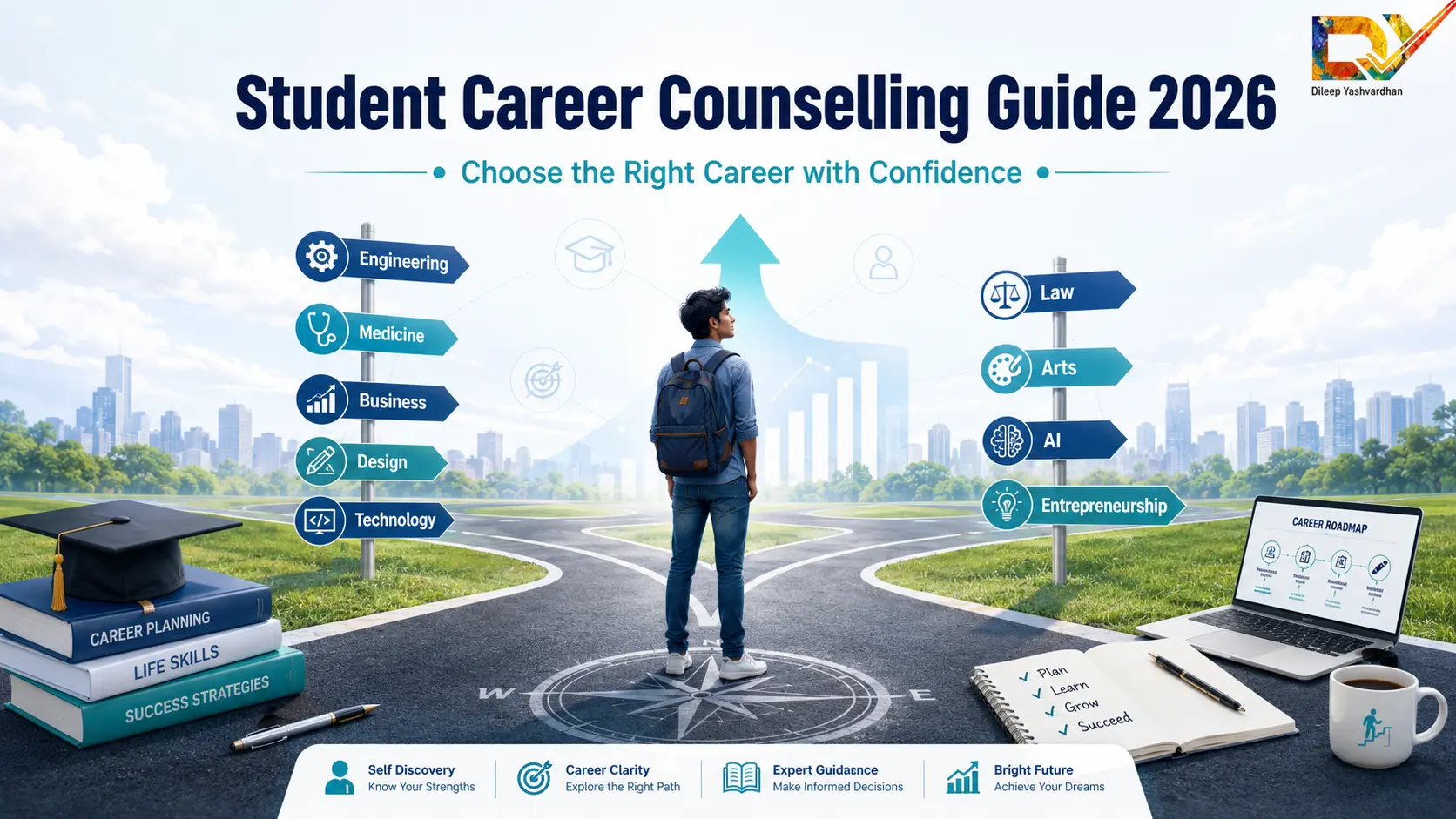
Picture this. You have just received your Class 10 board results. The form asking you to select Science, Commerce, or Arts is sitting on the table. Your father wants engineering. Your mother says medicine is safer. Your best friend has already chosen Science. And somewhere in the middle of all this noise, you have no idea what you actually want.
This is not a rare situation. It is the reality for millions of students across India every single year.
The real problem is not that there are too few career options. The problem is that most students are asked to choose before they understand themselves. They pick careers based on peer pressure, trending salaries, or family expectations — not on a genuine understanding of their own strengths, interests, and values.
This is exactly why student career counselling exists — and why it matters far more than most people realise.
This guide covers what student career counselling actually is, when to seek it, what happens in a career counselling session, and a practical framework for making a career decision that genuinely fits who you are. Whether you are choosing a stream after 10th, navigating courses after 12th, or a graduate wondering if you picked the wrong path — this guide is for you.
What Is Student Career Counselling — And What It Is Not
Student career counselling is a structured guidance process that helps students understand their strengths, interests, values, and personality — and use that self-knowledge to make informed decisions about their education and career path.
It involves self-assessment, career exploration, goal-setting, and a clear action plan. A trained career counsellor does not hand you a career on a piece of paper. They guide you through a process of discovery — helping you understand who you are before discussing where you should go.
What it is not: a test that tells you what to become. It is not a shortcut for stream selection. And it is definitely not generic advice from someone who does not know you.
Student career counselling replaces guesswork with clarity. That distinction matters enormously.
Career Counselling vs. Career Advice — A Critical Distinction
Most people use these two terms as though they mean the same thing. They do not.
Career Advice | Career Counselling |
Someone tells you what to do | A counsellor helps you discover the answer |
Based on the advisor’s experience or opinion | Based on your own self-assessment and exploration |
One-directional — you receive information | Two-directional — you participate in the process |
Outcome: an answer | Outcome: self-awareness and a reasoned direction |
No structured process | Follows a structured, stage-by-stage process |
Can be given by anyone | Delivered by a trained professional |
Advice gives you answers. Student career counselling gives you understanding.
This is why career counselling for students creates lasting results while career advice often leads to second-guessing. When you understand why a path fits you, you commit to it differently. This is the core philosophy behind Dileep Yashvardhan’s approach to life management: Understanding Creates Lasting Change.
Why Career Clarity Matters More Than Career Choice
Most career content on the internet jumps straight to the destination — salary packages, entrance exams, trending job titles. It skips the most important question entirely: Who are you?
Career confusion is not about having too many options. It is about having no framework for choosing between them. Career clarity comes from understanding yourself well enough that the right options naturally rise to the top.
Students who choose a career based on what is trending, what pays well right now, or what their parents expect often arrive at their destination and realise it does not fit. The course feels wrong. The work does not engage them. And by then, years have passed.
The self-awareness sequence that guides real career clarity looks like this:
Strengths → Interests → Values → Personality → Career Direction
Each step builds on the one before it. Skipping any step weakens the entire decision. This is what strengths alignment really means — not just knowing what you are good at, but matching those strengths to a direction that also fits your values. Values-based decision making is what separates a career that looks good on paper from one that actually sustains you over time.
Choosing a career without self-awareness is like navigating without a map. You may arrive somewhere — but rarely where you intended.
What Happens in a Career Counselling Session
Most students avoid student career counselling because they do not know what to expect. The reality is more structured — and more useful — than a simple test and a printout.
A career counselling session typically moves through three clear stages.
Stage 1 — Self-Assessment and Exploration
The first stage is about discovery. A career counsellor will use a combination of aptitude testing, interest inventories, personality assessments, and values clarification exercises. Aptitude testing measures logical, verbal, numerical, and spatial reasoning — giving a data-backed picture of how a student naturally processes information and solves problems.
Tools commonly used include the Holland Code (RIASEC) career assessment and personality frameworks that reveal working style preferences.
What these reveal: patterns in how you think, what kinds of problems engage you, and what environments suit you best. What they do not do: tell you which specific career to choose. They narrow the landscape significantly. The actual direction emerges from the career guidance session that follows.
Stage 2 — Career Exploration and Alignment
With self-assessment results in hand, the career counsellor maps your strengths, interests, and values to career categories that genuinely align with who you are. This stage covers higher education pathways, how different career directions connect to your long-term lifestyle goals, and early skill development areas to focus on now.
The goal is not to overwhelm you with options. It is to move from a wide landscape to a focused shortlist — based on genuine alignment, not assumption.
Stage 3 — Goal Setting and Action Planning
The final stage moves from clarity to direction. A personalised career action plan is built — covering your next educational step, skill gaps to address, a realistic timeline, and review milestones.
Career planning is iterative, not a one-time event. Life changes. Interests evolve. The plan is a living document, not a permanent decision.
Career Counselling at Every Stage
Student career counselling is not just for 12th-grade students. Each stage of education and early career has its own clarity needs.
After 10th — Choosing the Right Stream
Stream selection after 10th is one of the most consequential decisions in an Indian student’s journey. The most common mistake at this stage: choosing a stream based on marks, not interests. A student scoring well in Science does not automatically belong in the Science stream — especially if their genuine curiosity lies elsewhere.
A structured career guidance session at this point helps answer the questions that actually matter:
- Which subjects genuinely energise you — not just which ones you score well in?
- What careers are you curious about — and which stream leads there?
- What does your personality suggest about your natural direction?
Student career counselling after 10th prevents years of misalignment and the painful mid-course corrections that follow.
After 12th — Navigating the Biggest Decision
The pressure after 12th is intense. College applications, entrance exams, family expectations, peer comparison — all arriving at the same time. Most students make course and college decisions reactively, under time pressure, without a structured process.
Student career counselling after 12th provides exactly that structure. It focuses on course alignment first — which field genuinely matches your strengths and interests — and college selection second. The most common mistake at this stage is choosing a college brand over course-career alignment. A well-known college in the wrong field still leads to the same misalignment problem.
After Graduation — When the First Choice Did Not Fit
A significant number of graduates realise, one to three years into their field, that the career they chose does not fit who they have become. This is not failure. It is a clarity opportunity — and it is more common than most people admit.
Post-graduation career counselling addresses transferable skills, realistic pivot options, and whether further education or a direct career shift makes more sense. Individual transformation coaching through Dileep Yashvardhan’s programmes is specifically designed for this stage.
Common Career Planning Mistakes Students Make
These are mistakes to recognise — not fear. Awareness is always the first step toward correction.
Choosing based on trends, not fit. A career in demand today may look very different in ten years. A career that fits you will adapt with you.
Letting exam scores decide the career. Scores measure performance at a specific moment. They do not measure potential, passion, or purpose.
Skipping self-assessment and jumping to options. Choosing from a list of careers without self-knowledge is like shopping without knowing your size. Something will fit — but rarely well.
Treating the first career decision as permanent. It is not. Career paths evolve. The goal is not a perfect first choice — it is a well-informed first step.
Ignoring emotional factors. Passion, fear, family expectations, identity — these influence career decisions whether acknowledged or not. A structured career guidance session brings them into the open.
The most expensive career mistake is the one made without awareness. The most recoverable one is too — because awareness can always be built.
How to Choose the Right Career Counsellor
Not all career counsellors are equal. Here is what to look for.
A structured process, not just a conversation. A good counsellor follows a clear methodology — self-assessment, exploration, alignment, action planning. If there is no process, there is no foundation.
Self-awareness focus — not just career options delivery. The career counsellor’s job is not to hand you a list. It is to help you understand yourself well enough to build your own shortlist.
Audience fit. Student career counselling for a 10th-grade student looks different from counselling for a working professional. A career counsellor who specialises in Indian students — board exam context, stream selection, entrance exam pressures — will serve you better than a generic service built for a different market.
A life management perspective. Career clarity does not exist in isolation from personal values, lifestyle goals, and family context. A career counsellor who treats career choice as purely academic is missing half the picture.
Red flag: A counsellor who gives you a career answer in the first ten minutes — before any meaningful self-exploration — is not counselling. They are advising. And that distinction matters enormously.
Dileep Yashvardhan’s approach to student career counselling is grounded in life management. The work begins with understanding the person — their values, their strengths, their context — before any career direction is discussed.
Frequently Asked Questions
What is student career counselling?
Student career counselling is a structured process that helps students understand their strengths, interests, and personality to make informed education and career decisions.
Why is career counselling important for students?
It replaces guesswork with clarity, helping students choose careers based on self-awareness instead of trends, marks, or external pressure.
When should a student seek career counselling?
Ideally before key decisions — after 10th, 12th, or graduation — but it is never too late to gain career clarity.
What happens during a career counselling session?
The career counselling session includes self-assessment, career exploration, and a personalised action plan with clear next steps.
How is career counselling different from career advice?
Career advice gives opinions. Student career counselling uses a structured process to help you discover the right path yourself.
Can career counselling be done online?
Yes. Online career counselling is highly effective when delivered through a structured process by a qualified career counsellor.
How do I know if I need career counselling?
If you are confused about your career, feeling pressured, or unsure about your current path, student career counselling can provide the clarity and direction you need.
Conclusion
Career clarity is not found in a list of options. It is built through self-understanding.
The right career is not the most popular one, the safest one, or the one that earns the most approval. It is the one that genuinely fits who you are – your strengths, your interests, your values, and the kind of life you want to build.
The pressure students face in India is real. Board exam results, family expectations, peer comparison – these are not imaginary forces. But clarity is always stronger than pressure. When you understand yourself, the noise around you becomes much easier to filter.
As Dileep Yashvardhan’s work consistently demonstrates: Understanding Creates Lasting Change. Knowing yourself is not a step in student career counselling. It is the entire foundation.
Work With Dileep Yashvardhan
If you are a student, parent, or young professional looking for structured career guidance that goes beyond tests and generic lists — Dileep Yashvardhan offers student career counselling and youth development sessions designed to build genuine clarity about your path forward. His approach is rooted in life management, understanding the whole person before recommending any direction.