

Many people try hard to change their life. They read books, follow motivational pages, and set new goals every January. Yet somehow, a few months later, they feel stuck again. This is a common experience, and it’s one of the reasons many people begin searching for a 1 to 1 life coach in India. Motivation alone rarely creates lasting change. Real, sustainable transformation starts with understanding—understanding your own patterns, reactions, and the habits quietly shaping your daily life.
This is exactly why more people across India are now choosing a 1 to 1 life coach in India instead of relying only on generic advice or short-lived motivational content. A one-on-one coach helps a person slow down and understand their own situation first, and only then guides them toward practical action. This idea sits at the heart of Dileep Yashvardhan’s coaching philosophy: “समझोगे तो काम आएगा” (Understanding Creates Lasting Change).
In most cases, people don’t need another list of tips. They need someone who can help them see their own blind spots clearly. This guide explains what one-on-one life coaching actually means, how the process works, who it’s useful for, and how to choose the right coach for real, lasting growth — not just a temporary motivation boost.
What Is a 1 to 1 Life Coach?
A one-on-one life coach works directly with a single individual, rather than delivering the same generic message to a large audience. This is quite different from a motivational speaker, a self-help book, or an online course built for thousands of people at once.
A personal life coach listens first. They take time to understand a person’s background, their current challenges, and what “progress” actually means for that individual. Only after this discovery stage does the coaching move toward goals and action steps. This is what makes personalized coaching more effective than a fixed script — the guidance is shaped around real life, not assumptions.
Dileep Yashvardhan follows this model closely in his own practice as a life management coach. His sessions are built around the client’s actual circumstances, not a generic checklist copied across every client. Two people struggling with “stress,” for example, may need completely different approaches — one might need better time management, while the other might need to understand an underlying fear of failure.
This is also why a 1 to 1 life coach in India tends to deliver results that group workshops often can’t. In a group setting, everyone hears identical advice, regardless of whether it applies to them. In one-on-one coaching, the conversation is shaped entirely around one person’s real habits, blind spots, and goals.
Why Do People Seek a 1 to 1 Life Coach in India?
People usually reach out to a life coach when something in their daily routine starts feeling harder than it should, even though nothing dramatic has happened. A few reasons come up again and again.
Stress and overwhelm often build up quietly, when work deadlines, family responsibilities, and personal goals all pull in different directions at the same time. Many people don’t realize how much this is affecting their decisions until someone points it out clearly.
Lack of clarity is another common trigger for coaching. A person can feel busy from morning to night, yet still feel unsure whether any of that effort is moving them toward something meaningful.
Career challenges bring in a large number of working professionals — feeling stuck in a current role, considering a career switch, or struggling with confidence in meetings and leadership situations.
Relationship issues are also common, whether at home or at work. Communication problems often trace back to stress or unspoken expectations rather than the relationship itself.
Confidence and self-doubt, along with ongoing work-life balance struggles, round out the list. In most cases, these issues are connected rather than separate. Someone dealing with constant work pressure often carries that same tension into personal relationships without even noticing it.
This is exactly where individual transformation coaching becomes useful. Instead of treating each problem in isolation, a good coach looks at the whole picture — habits, mindset, and circumstances together.
How Does One-to-One Life Coaching Work?
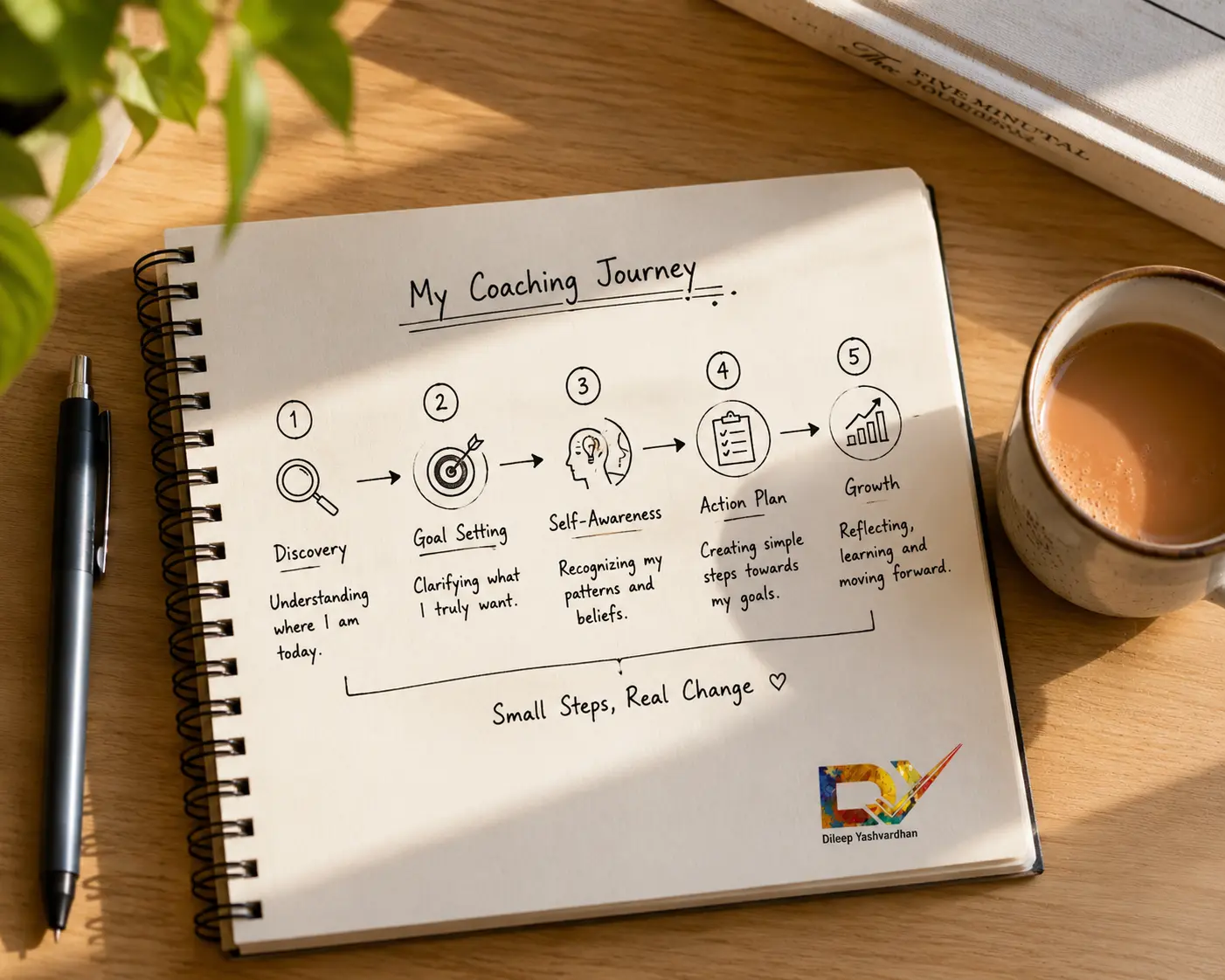
Life coaching is not just an open conversation. In most professional practices, it follows a structured, repeatable process, even though every session feels personal and conversational.
| Stage | What Happens |
|---|---|
| Discovery | The coach understands the person’s background, habits, and current challenges in depth |
| Goal Setting | Clear, realistic, and measurable goals are defined together, not assumed |
| Self-Awareness | The client learns to recognize their own thought patterns, triggers, and default reactions |
| Action Planning | A practical, step-by-step plan is built around the client’s actual life and schedule |
| Reflection & Accountability | Regular check-ins track progress, adjust the plan, and keep momentum going |
This structured flow keeps coaching practical rather than purely inspirational. It also explains why online life coaching in India has grown steadily in recent years — this same five-stage process works just as well over a video call as it does in person, as long as the coach and client stay consistent with sessions.
For working professionals in particular, this format is useful because it doesn’t demand a fixed weekly commute. A session can happen during a lunch break or after work hours, without losing the depth of the conversation.
Understanding vs Motivation: Why Lasting Change Needs More Than Inspiration

Motivation is easy to find and just as easy to lose. A single motivational video or quote can lift someone’s mood for a day or two, but within a week, old habits usually creep back in. This happens because motivation mostly works on emotion. It doesn’t address why the old habit exists in the first place.
Understanding works differently. When a person understands why they procrastinate, why they react a certain way in relationships, or why they feel stuck at work despite trying hard, the change that follows tends to feel natural rather than forced. They no longer need a fresh dose of motivation every morning, because the shift now comes from clarity rather than willpower alone.
This is the core idea behind Dileep Yashvardhan’s coaching approach and his signature philosophy: “समझोगे तो काम आएगा.” Instead of pushing clients with generic pep talks or one-size-fits-all frameworks, sessions are built around helping each person understand their own behavior first. Once that understanding is genuinely in place, taking action becomes far easier to sustain over months, not just for a few days.
This is also what separates a genuine 1 to 1 life coach in India from short-lived motivational content available freely online. Motivation fades within days. Understanding, once it settles in, tends to stay — and that’s usually what clients notice looking back after a few months of consistent coaching.
Benefits of Working with a Personal Life Coach
Working consistently with a coach tends to bring benefits that go well beyond solving one specific problem.
Better decision-making is often the first shift people notice, since a person becomes clearer about their own priorities instead of reacting to whatever feels urgent. Emotional clarity usually follows closely behind — many clients realize they were reacting to old, familiar patterns rather than to the actual situation right in front of them.
Improved confidence builds gradually as small wins accumulate week after week. This isn’t about sudden transformation; it’s steady progress that compounds over time. Stronger relationships are another common outcome, since better self-awareness naturally improves how a person communicates with family, colleagues, and friends.
Over time, these smaller shifts add up to genuinely sustainable personal growth — not a short-lived motivational spike, but a real, lasting change in how a person thinks, decides, and responds to daily challenges.
Who Can Benefit from a 1 to 1 Life Coach?
One-on-one coaching is useful for a wide range of people, not only those going through a personal crisis.
- Students dealing with academic pressure, exam stress, or unclear career direction after school or college
- Professionals feeling stuck in their current role, unsure about the next career step, or struggling with workplace confidence
- Entrepreneurs managing constant decision fatigue and stress while trying to scale a business
- Leaders and managers who want sharper decision-making, better communication, and stronger people skills
- Parents trying to balance family responsibilities with their own personal goals and identity
In most cases, people come to coaching not because something is broken in their life, but because they want more clarity, direction, and control over decisions they’re already making every day.
How to Choose the Right 1 to 1 Life Coach in India
Choosing a coach is a personal decision, so it helps to ask a few honest questions before committing to a program.
Does their coaching philosophy actually match your needs? A coach who focuses only on short bursts of motivation may not help much with deeper, recurring patterns that keep repeating in your life.
Do they explain their approach clearly? A good coach should be able to explain how sessions are structured and what progress looks like, rather than simply promising big results upfront.
Is there genuine trust and comfortable communication? Coaching often involves discussing personal struggles openly, so a comfortable rapport with the coach matters just as much as their experience or credentials.
Is the guidance actually personalized? A life management coach who tailors each session to the individual is usually far more effective than one running every client through the same fixed script.
Life Coach vs Mentor vs Therapist
People often confuse these three roles, so a quick side-by-side comparison helps clarify the difference.
| Aspect | Life Coach | Mentor | Therapist |
|---|---|---|---|
| Primary Focus | Present habits and future goals | Career or skill-based guidance | Past experiences and mental health |
| Approach | Structured, action-oriented sessions | Experience-based advice from someone senior | Clinical, diagnosis-based treatment |
| Best Suited For | Personal growth, clarity, and building better habits | Career direction from someone who has “been there” | Diagnosed emotional or psychological conditions |
A 1 to 1 life coach in India is best suited for people who are already functioning reasonably well in daily life but want more clarity, direction, and self-understanding. It is not intended to replace medical or psychological treatment where that is genuinely needed.
Common Myths About Life Coaching
“Coaching is only for people with serious problems.” In reality, a large number of clients come to coaching simply because they want to grow further, not because something is broken in their life.
“A coach gives all the answers.” A good coach actually helps a person find their own answers through better self-understanding, rather than simply handing out instructions to follow blindly.
“Motivation alone is enough to change.” As explained earlier, motivation tends to fade quickly once the initial excitement wears off. Lasting change generally needs understanding first, and action second.
“Coaching gives instant results.” Like most meaningful personal change, coaching works gradually over weeks and months. Most clients notice steady, visible progress across several sessions rather than an overnight transformation.
Frequently Asked Questions
What does a life coach do?
A life coach helps a person understand their own patterns, set realistic goals, and build a practical, step-by-step plan for personal growth. The focus stays firmly on the present and future, rather than diagnosing past issues.
How many sessions are typically needed?
This varies from person to person, but many clients notice meaningful clarity within the first few sessions, with deeper, lasting change usually developing over a few months of consistent work together.
Is coaching confidential?
Yes. Personal coaching sessions are private by nature, and whatever is discussed stays strictly between the coach and the client.
Is online life coaching effective in India?
Yes, in most cases. Many clients now actively prefer online sessions for convenience, and the same structured coaching process works well over video calls without losing its depth or effectiveness.
What should I expect from the first session?
The first session usually focuses on understanding your background, current challenges, and goals in detail, rather than jumping straight into quick-fix solutions.
Is life coaching different from counseling?
Yes, meaningfully so. Life coaching focuses on present-day goals and future growth, while counseling more often addresses past experiences and diagnosed mental health concerns.
Conclusion
Real, lasting transformation rarely comes from a single motivational push or a burst of inspiration. It comes from understanding yourself clearly enough to make changes that actually stick, one step at a time. This is exactly the philosophy behind Dileep Yashvardhan‘s coaching practice — “समझोगे तो काम आएगा.”
If you’ve been searching for a 1 to 1 life coach in India who focuses on genuine understanding rather than quick fixes or generic motivation, exploring a personal coaching session could be a good starting point toward clearer thinking and more confident decision-making.